Permaculture
Permaculture is: sustainable agriculture, alternative energy, ethical investment, organic gardening, whole farm planning, bioregionalism, eco-villages, appropriate technology, alternative economics, solving problems... and much more!
Click here to find out when we are running our next Permaculture Design Certificate (PDC) and other permaculture-related courses.
Permaculture (permanent agriculture) is a framework for thinking about and designing environmentally sustainable farms, gardens, buildings and communities. It aims to create systems that will sustain not only for the present, but for future generations.
It is based on a philosophy of co-operation with nature and each other and of taking responsibility for our impact on population and consumption of things which have high environmental costs. It encourages the individual to be resourceful and self-reliant and become a conscious part of the solution to the many problems which face us both locally and globally.
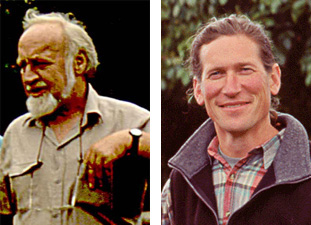 Permaculture presents an approach to designing environments which have the diversity, stability and resilience of natural ecosystems and also the productivity of naturally improved plant varieties and technologies from many cultures and countries. It was devised by Bill Mollison, pictured left, (who worked on the land for many years and spent time in both the CSIRO and the University of Tasmania) and David Holmgren, pictured right, (an environmental designer who runs a property and a farm design service in Victoria, Australia).
The principles of Permaculture are laid out in the 'Permaculture Designers Manual' and 'An Introduction to Permaculture'. They are based on a combination of modern science and traditional wisdom.

|
The Food Forest presents a Permaculture Design Certificate Course each summer and many other short courses on weekends. Many other courses are taught elsewhere on the planet, you can find out about them through State and Bioregional groups and various magazines (like 'Earth Garden' and the ABC's 'Organic Gardener').
Permaculture Principles and Technologies
Processes, principles and technologies used in Permaculture design include:
- Reading the landscape - Each property falls within a broad landscape which provides a broad set of limits to the capability of the land and suggests the nature and most likely location of potential catastrophic events such as floods, elevation of salty water tables, fire, black frosts etc. Beyond that an individual property is analysed in terms of microclimates, soils, topography, aspect, water, wind, existing vegetation, frost pockets, lime outcrops, access etc to enable detailed planning within the regional land capability limits. Maps, aerial photos and plastic overlays are used.
- Placement of elements in the design - The intelligent placement of windbreaks, shade trees and biodiversity plantings, particular orchard blocks, packing sheds, animal housing and handling facilities, plantings for the utilization of waste water, the house etc can lead to a smoothly operating, healthy system.
- Energy - A permaculture design is done not just spatially (where things are placed on the ground) but also in terms of energy flow. This will produce a property which minimises the use of outside resources and production of waste.
- Using biological resources - Many functional horticultural operations can be carried out by plants or animals without external inputs - pest management, weed control, fertiliser application, Nitrogen fixation, shade, shelter etc.
- Multifunctional elements - A dam can provide for fire control, waterbird habitat and a cooling and aesthetically pleasing outlook for the house, a leguminous ground cover controls dust and weeds, fixes Nitrogen, provides grazing and bee forage. The more of these useful elements there are in a design the more productive and stable it becomes.
- Important functions of the property are served by various elements. A job like weed control can be achieved by, grazing, mowing, mulching, shading, outcompeting, hoeing, spraying, flaming, steaming, parasitising etc. Marketing can be done by farm gate sales, subscription farming, local sales to retailers and restaurants, regional, national or export. Value-adding before sale adds another dimension.
A community-based movement
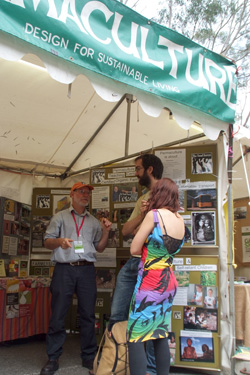 Permaculture is very much a community-based movement. Associations, bioregional groups and collectives operate in each country to support members, share information and resources and to promote permaculture practices.
One such organisation is The Permaculture Association of South Australia. This non-profit voluntary resource body meets monthly and provides information through a regular newsletter and facilitates courses, seminars and field visits to homes, gardens and farms which demonstrate permaculture.
Another excellent site with many Permaculture links is Permaculture Australia.
There are farms and households all over the World operating on Permaculture principles. Many Permaculture farmers host 'willing workers on organic farms'. Details are at the WWOOF Australia's website.
Permaculture in action
Permaculture is most effective at property and regional level where we are dealing with common values of resources. It works extremely well within a relatively closed economy where the preservation of the environment and the right of every person to a life of health and dignity are valued. When World trade puts commodities onto the market from places that do not share these values, the consequence is that ecologically sustainable systems sometimes appear to become uneconomic.
Whilst Permaculture systems can export ethically produced goods to people who value environmental sustainability (Europe in particular) it remains an aim to convert all systems to a sustainable footing.
Click here to find out when we are running our next Permaculture Design Certificate (PDC) and other permaculture-related courses.